
Compartmentalization in your house design
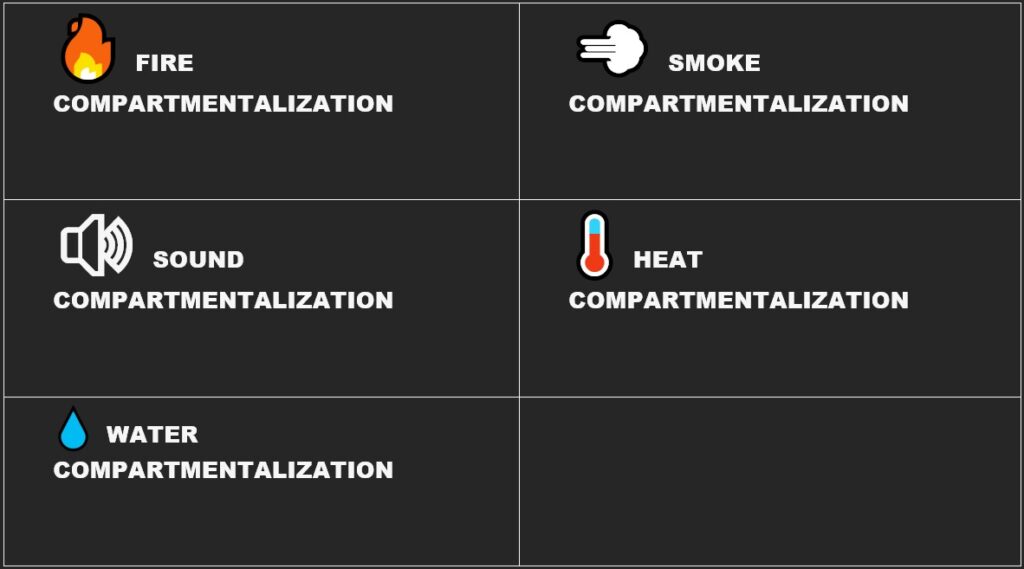
Compartmentalization in construction is a safety and control strategy used in building design. This means dividing a building into separate enclosed sections (compartments) to limit the spread of:
Thank you for reading this post, don't forget to subscribe!1. 🔥 Fire
This is the most common. If a fire starts in one area, it stays there for a specific time (e.g., 30, 60, 120 minutes). This protects:
Occupants, Escape Routes & Structural Stability
- Fire-rated walls
- Fire-rated floors
- Fire doors
- Fire dampers in ducts
2. 💨 Smoke
Smoke compartmentalization is a building design strategy where a structure is divided into sections to prevent smoke from spreading from one area to another during a fire. In most fires, smoke kills faster than flames because:
- It reduces visibility
- It contains toxic gases (CO, etc.)
- It causes rapid suffocation
- It spreads faster than fire
3. 🔊 Sound / Acoustic
Acoustic compartmentalization is a building design strategy where a structure is divided into sections to prevent sound from traveling from one space to another. Its importance:
- Privacy
- Comfort
- Building Performance
4. 🌡 Heat / thermal
Thermal compartmentalization is a building design strategy where a structure is divided into separate sections (compartments) to control the transfer of heat between spaces. Its Importance:
Fire Safety
-
- During a fire, heat and flames are contained within one compartment.
- This slows fire spread and gives occupants more time to escape.
- Common in apartments, hospitals, schools, and commercial buildings.
Energy Efficiency
-
- Reduces unwanted heat loss or gain between spaces.
- Improves HVAC performance.
- Helps maintain stable indoor temperatures.
Comfort & Performance
-
- Keeps different rooms at controlled temperatures.
- Useful in buildings with mixed-use spaces (e.g., server room vs office).
5. 💧 Water
Water compartmentalization is a building design strategy where a structure is divided into separate watertight sections to prevent water from spreading from one area to another. This reduces risk of:
- Dampness
- Mold growth
- Reinforcement corrosion
- Material deterioration
Conclusion
Compartmentalization is a fundamental aspect of building design that enhances safety, comfort, and energy efficiency. By understanding its various applications and benefits, architects and builders can create spaces that not only meet safety standards but also improve the quality of life for occupants. As we move forward, embracing new technologies and practices will be crucial in maximizing the potential of compartmentalization in future structures.
Future Trends in Compartmentalization
As building designs continue to evolve, new trends in compartmentalization are emerging. The integration of smart technologies allows for dynamic compartmentalization, where partitions can be adjusted based on real-time needs, optimizing space usage while maintaining safety. These innovations promise to revolutionize how we think about compartmentalization in modern architecture.
Benefits of Compartmentalization
The benefits of compartmentalization extend beyond safety. Efficient design can lead to enhanced energy performance and reduced utility costs. For example, separating heating and cooling systems in a building allows for targeted temperature control, ultimately leading to lower energy bills.
Real-world Applications of Compartmentalization
In hospitals, compartmentalization plays a critical role in separating patient rooms from high-traffic areas. This not only ensures patient privacy but also limits the spread of infections. Similarly, schools utilize compartmentalization to control sound levels, allowing students to focus on their studies without disruptive noise.
Examples of Compartmentalization
Consider a multi-story apartment building. Each floor can be designed as a separate compartment to ensure residents’ safety in case of a fire. Fire-rated doors and walls can delay fire spread, allowing time for evacuation. In addition, sound compartmentalization can be applied to create a peaceful living environment, ensuring that noise from common areas does not invade private units.
Compartmentalization is vital for enhancing safety and efficiency in building design. It ensures that different zones within a building serve distinct functions while providing safety measures against various hazards. For instance, in residential designs, compartmentalization can effectively separate living spaces from utility areas, minimizing the risk of hazards affecting everyday life.
