Thank you for reading this post, don't forget to subscribe!
Dangers of rust on reinforcement bars
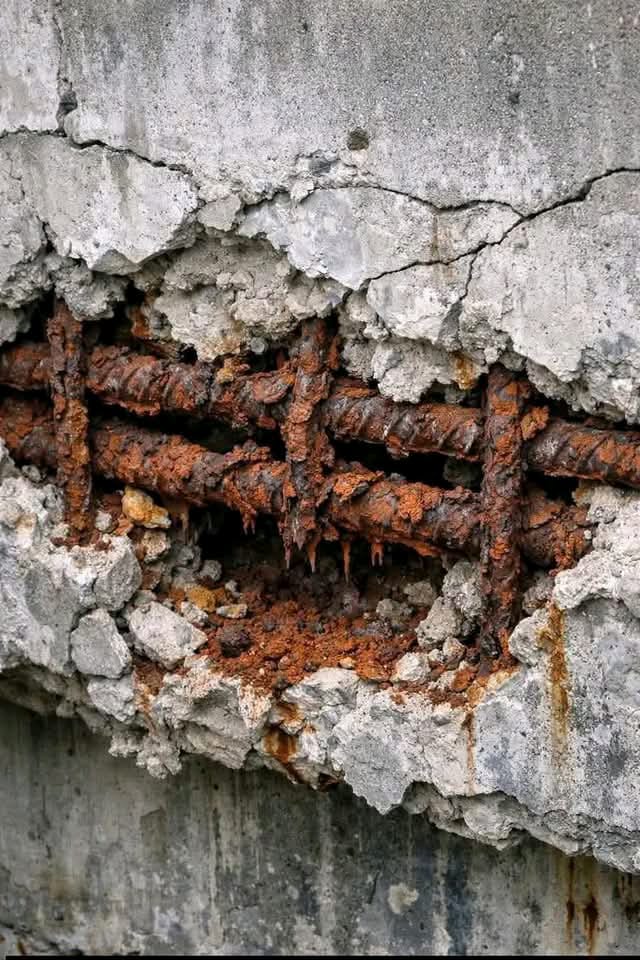
Rust on reinforcement bars (rebar) is a serious concern because it can reduce the strength, durability, and service life of a reinforced concrete structure. However, not all rust is harmful. A light, uniform surface rust is usually acceptable, while heavy rust, scaling, or pitting is not.
1. Reduced bond with concrete
Concrete relies on a strong bond with the steel bars. Thick rust, loose scale, or flaking rust prevents proper adhesion, reducing the bar’s ability to transfer loads.
Result:
-
Cracks may develop.
-
Reinforcement may slip within the concrete.
2. Reduced bar diameter
Severe corrosion gradually consumes the steel, reducing its cross-sectional area.
Result:
-
Lower tensile strength.
-
Reduced load-carrying capacity.
For example:
-
A 16 mm bar heavily corroded to an effective diameter of 14 mm has lost a significant portion of its steel area and strength.
3. Cracking and spalling of concrete
Rust occupies more volume than the original steel (often several times greater). As it expands, it exerts pressure on the surrounding concrete.
Result:
-
Longitudinal cracks along the reinforcement.
-
Concrete cover breaks away (spalling).
-
Steel becomes exposed to more moisture, accelerating corrosion.
4. Shortened service life
Corrosion continues if moisture, oxygen, and chlorides reach the steel.
Result:
-
Increasing maintenance costs.
-
Premature deterioration of the structure.
5. Structural failure
If corrosion becomes extensive, critical members such as beams, slabs, or columns may lose significant strength.
Result:
-
Excessive deflection.
-
Shear or flexural failure.
-
In extreme cases, partial or complete collapse.
When is rust acceptable?
Generally, light surface rust is acceptable if:
-
The bar retains its original diameter.
-
There is no loose or flaking rust.
-
There are no deep pits.
-
The bar passes inspection.
This light rust can even improve the bond between steel and concrete.
When should the bar be rejected?
Replace or reject reinforcement if you observe:
-
Heavy flaking rust.
-
Deep pitting corrosion.
-
Significant reduction in bar diameter.
-
Laminated or delaminated steel.
-
Bent bars cracked due to corrosion.
How to clean rusty reinforcement
Before casting concrete:
-
Remove loose rust with a wire brush.
-
Use a power wire brush or grinder for heavier rust.
-
Avoid painting reinforcement unless the design specifically calls for coated reinforcement (e.g., epoxy-coated bars).
-
Ensure the bars are free from mud, oil, grease, and loose scale.
Best practices during construction
-
Store reinforcement off the ground on timber or concrete supports.
-
Cover bundles with a waterproof sheet while allowing ventilation.
-
Avoid prolonged exposure to rain before use.
-
Maintain the specified concrete cover (e.g., 25–50 mm depending on the element and exposure conditions) to protect the steel after casting.
Practical advice for your site
As someone supervising building projects in Kenya:
-
Light brown surface rust after a few weeks outdoors is usually acceptable once cleaned.
-
Heavy, flaky, or deeply pitted rust should be reported to the structural engineer, and the affected bars should generally be replaced rather than used.
This approach helps ensure the reinforced concrete performs as intended over its design life.
